






By Gerald C. Koinyeneh | FrontPage Africa
In the heart of Weala, what was once forestland has been transformed into one of Liberia’s most ambitious industrial projects: a modern rubber processing plant that could reshape the country’s economic future.
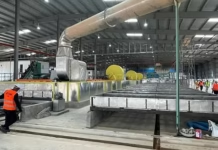
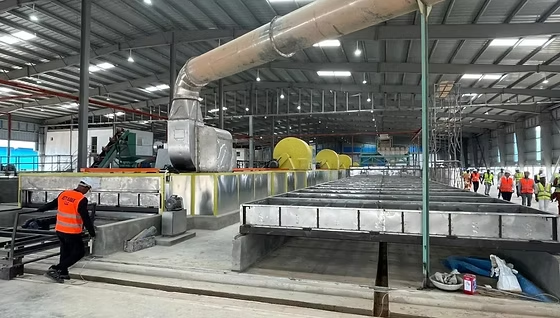
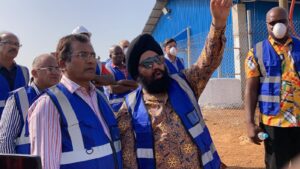
On April 2, the FrontPage Africa team toured Jeety Rubber LLC, where machines roared, workers moved with precision, and raw rubber flowed steadily into production. At the center of it all is businessman Upjit Singh Sachdeva—popularly known as Jeety—whose $18 million investment is positioning Liberia as a potential manufacturing hub in West Africa.
Jeety, who describes himself as “Liberian by heart,” began this journey with a simple idea: to do something transformative that had never been done before in Liberia. In 2021, he signed an investment incentive agreement with the government to establish a Technical Specified Rubber processing plant. Construction started in mid-2022, test operations followed in late 2023, and by May 2024, full commercial production was underway. Built entirely from scratch, the facility stands as a rare greenfield development in Liberia’s industrial landscape.
His ambitions grew further in 2024 when unrest forced the closure of the Salala Rubber Corporation. Rather than watch a key player collapse, Jeety moved quickly to acquire and integrate it into his company, stabilizing the sector while expanding operations. Today, Jeety Rubber processes five tons of rubber per hour, with plans to more than double capacity by 2026. Yet his vision goes beyond processing: he wants Liberia to produce its first locally made tyres. “If we get consistent supply—500 to 550 tons of rubber daily—we will produce the first ‘Made-in-Liberia’ tires,” he said, outlining plans to manufacture truck, car, motorcycle, and tricycle tyres for both domestic and regional markets.
Direct Engagement with farmers
Central to his model is direct engagement with farmers. Unlike traditional systems plagued by delays, Jeety Rubber pays cash on delivery, a policy that has won praise among suppliers. Combined with government reforms, including a National Rubber Price Committee that set factory-gate prices higher than in Côte d’Ivoire, farmers say they are finally seeing relief. The company also employs nearly 900 Liberians, with plans to add 400 more jobs, and is breaking industry norms by training women to operate heavy machinery—roles long dominated by men.
Challenges remain, particularly with electricity. The plant consumes up to 5,000 gallons of diesel daily to power generators, prompting Jeety Rubber to build a Heavy Fuel Oil power plant expected to generate 20 megawatts within two years. On the environmental front, the company has invested in large-scale effluent treatment systems capable of recycling 60 percent of its water usage, aiming to meet national compliance standards.
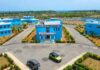
Beyond business, Jeety has made community development a priority. His company has built boreholes, sponsored students, installed streetlights, upgraded clinics and schools, provided ambulances and buses, and feeds hundreds of children daily. Plans are also underway to construct Liberia’s largest eye hospital, building on earlier outreach that funded surgeries for more than 125 patients.
Rethinking about raw rubber export
Yet Jeety warns that Liberia must rethink its reliance on exporting raw rubber. “When you export raw materials, you export jobs,” he said, pointing to Côte d’Ivoire’s success with over 40 processing plants as a model Liberia could follow. For him, the mission is deeply personal. “Liberia is my home. I’m an Indian by passport, Liberian by heart,” he said, adding that he wishes to be cremated in Margibi and have his ashes immersed in rivers near the factory.
The road ahead depends on securing a steady supply of raw rubber. If achieved, Liberia could soon witness a historic milestone—the production of its first locally made tyres, potentially at prices 20 percent lower than imports. For now, in the industrial corridors of Weala, that dream is steadily taking shape, transforming not just rubber, but Liberia’s industrial future.