












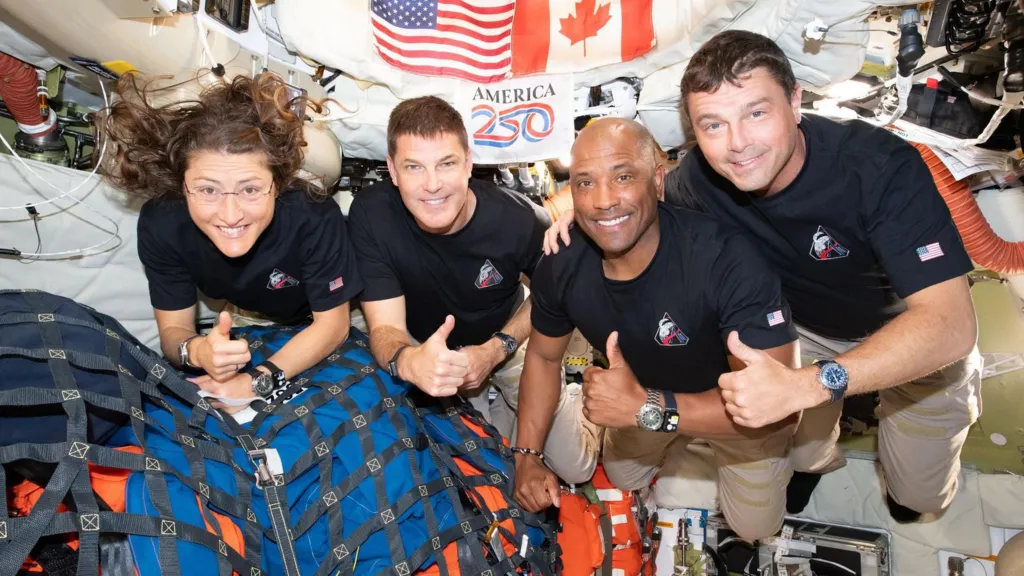
The four astronauts who flew in Nasa’s Artemis II mission around the Moon have splashed down safely in the Pacific Ocean after a flawless return.
The crew are now safely aboard a waiting ship and recovering from a nine-day voyage that took them further from Earth than any humans in history.
Their Orion spacecraft was travelling at more than 24,000mph (38,600km/h) when it hit the Earth’s upper atmosphere and its heatshield was subjected to temperatures half as hot as found on the surface of the Sun.
Their safe return clears the way for the next stage of the Artemis programme, which aims to land humans on the lunar surface and eventually build a permanent base on the Moon.
The extreme heat meant the capsule, which the astronauts named Integrity, lost contact with mission control in Houston for six minutes during the descent.
There were cheers when Commander Reid Wiseman’s voice was heard saying: “Houston, Integrity here. We hear you loud and clear.”
The mission’s moment of maximum jeopardy had passed, and soon the spacecraft’s red-and-white parachutes opened and sent the capsule sailing majestically through the sky.
“Good main chutes!” the Nasa commentary enthused repeatedly, until the capsule hit the ocean for a perfect splashdown.
“A perfect bull’s eye splashdown for Integrity and its four astronauts,” Nasa commentator Rob Navias said moments after the landing.
The astronauts – Wiseman, pilot Victor Glover, mission specialist Christina Koch and Canadian astronaut Jeremy Hansen – were carefully extracted from the capsule and taken by helicopter to the USS John P Murtha, where they will undergo medical evaluations.
Nasa said they would be flown to Houston to be reunited with their families on Saturday.
As they waited on the ship’s deck they could be seen smiling and chatting while posing for photos.
President Donald Trump welcomed them home and said the entire trip had been “spectacular”, repeating an invitation for them to visit the White House.
Nasa has not yet confirmed when they will make their first public appearance.
The Artemis II mission began its final descent at 19:33EDT (23:33GMT) when the European Space Agency-built service module – the cylinder of engines and solar panels that powered Orion throughout its lunar journey – detached.
Live pictures showed the capsule push gracefully away, homeward bound.
Next came the riskiest part, between re-entry into the Earth’s atmosphere and splashdown.
The capsule’s angle of approach had to be precise: too shallow and Orion might skip off the atmosphere like a stone off water; too steep and the heat would be damaging.
In the event, according to Nasa’s TV coverage, the angle of attack was perfect and the capsule hit a narrow target of sky southeast of Hawaii as it headed for the Californian coast.
Original Reporting by BBC