
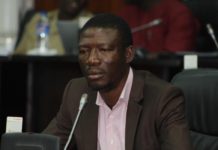
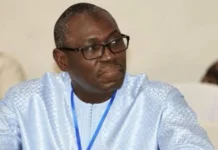






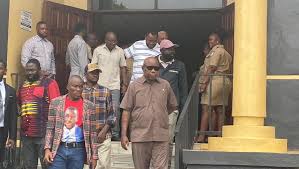
A Criminal Court jury on Friday acquitted former Finance Minister Samuel D. Tweah Jr. and former Financial Intelligence Agency Controller Moses P. Cooper of all charges in a high-profile corruption case, ruling that prosecutors failed to prove guilt beyond a reasonable doubt.
The verdict closes a months-long trial over the alleged diversion of US$6.2 million in state funds during the administration of former President George Weah. While Tweah and Cooper walked free, three other defendants were convicted on counts of theft and criminal facilitation.
Acquittals Rest on “Reasonable Doubt”
Jurors found insufficient evidence to convict Tweah and Cooper on charges including economic sabotage, theft of property, money laundering, criminal conspiracy, and criminal facilitation. Under Liberian law, the State must prove guilt beyond a reasonable doubt; suspicion or probability is not enough.
Defense lawyers argued that the transfers were authorized under the National Security Council framework, a claim prosecutors failed to rebut with documentary evidence or witness testimony.
Split Verdict
The jury convicted Nyanti Tuan, former Acting Justice Minister and Solicitor General; Stanley Ford, Director General of the Financial Intelligence Agency; and Jefferson Karmoh, former National Security Advisor. They were found guilty of theft of property and criminal facilitation. Sentencing is expected in the coming days, though defense teams may appeal.
The prosecution’s case faltered when Liberia Anti-Corruption Commission (LACC) lead investigator Baba Mohammed Boika admitted under cross-examination that his inquiry “did not extend to how the funds were spent.” He conceded investigators could not establish whether the money was personally misappropriated or identify who ultimately received it.
This raised a central question for jurors: without a clear money trail, on what basis could theft be alleged?
Defense Arguments
Tweah testified that prosecutors failed to show the National Security Council had not authorized the transfers. He emphasized there was no evidence of personal gain or intent to sabotage the economy.
Co-defendant Tuan reinforced this position, telling jurors that written instructions were “irrelevant and immaterial” in national security matters, and that Tweah acted within the NSC framework.
Legal analysts highlighted three key gaps in the prosecution’s case: the absence of a money trail, no proof of intent, and the failure to challenge the national security defense. Jurors cited these weaknesses in deliberations, returning acquittals for Tweah and Cooper.
The three convicted defendants await sentencing. The Liberia Anti-Corruption Commission has not indicated whether it will pursue appeals or retrials.