











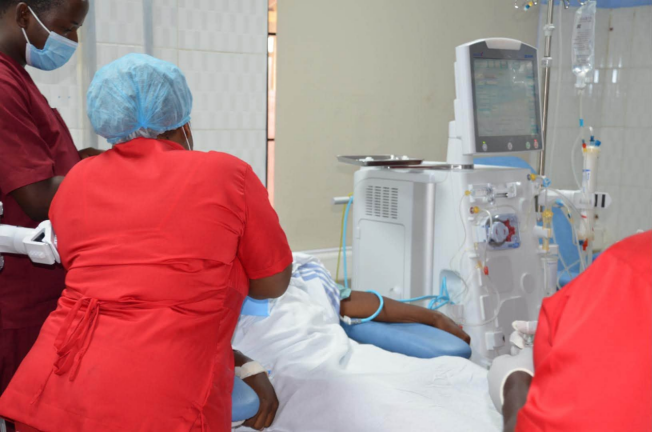
The management of the John F. Kennedy Medical Center has confirmed the findings of FrontPage Africa’s most recent investigation into the Ellen Johnson Sirleaf Dialysis Center.
According to an independent inquiry, the John F. Kennedy (JFK) Medical Center’s dialysis center is severely overcrowded, provides subpar medical care, and treats people with renal illness inhumanely, according to both patients and staff.
Patient testimonies, including those of Wilfred Gray-Johnson, Chairman of the Dialysis Patients Association at the JFK, and a few medical staff members who asked to remain anonymous out of fear of retaliation, paint an unbelievably bleak picture of how the nation’s sole public dialysis facility is finding it difficult to meet the rising demand for life-saving care.
Reports Validated
The management responded to the news report with a statement regarding the investigation’s findings, but the reply gave the publication more weight.
The Hospital acknowledged difficulties in maintaining what it refers to as “aging equipment” and the “limited availability” of manufacturer-specific replacement parts, as noted in the study.
The statement further notes that in order to increase patient access and service delivery, the hospital administration has purchased more dialysis equipment.
The statement states that “before being commissioned for patient care, the newly acquired machines are being installed and undergoing phased calibration and comprehensive technical validation by the Biomedical Engineering Team to ensure they meet all clinical, operational, and safety standards.”
Once fully commissioned, the management maintains that the additional machines will increase treatment capacity, improve service reliability, reduce patient waiting times, and expand access to life-saving dialysis services.
Par Remaining Parts
Important components of the machines, such as filters and cleaners, are allegedly missing and being purchased separately, despite the fact that the JFK announced that the machines would be installed.
According to reliable information provided to local media, the filters are being ordered from China and should arrive this weekend or early next week. Meanwhile, the cleaners are being ordered from neighboring Guinea, and Timothy, a biochemist from the Ministry of Health, is already in that country to obtain them. Even while the hospital acknowledged that its aging dialysis equipment were inadequate, it was unable to shed light on the reported deaths of two patients, the high cost of services, and President Joseph Nyuma Boakai’s inability to see the “deplorable” dialysis Crisis and Congestion at the JFK Dialysis Center
The chairman of the Dialysis Patients Association, Mr. Wilfred Gray-Johnson, has bemoaned the severe lack of resources at the JFK Dialysis Center, where he claims that just seven working machines are available to a growing patient population of 165.
Mr. Gray-Johnson revealed that because of this shortage, medical personnel frequently had to reschedule stable patients in order to give priority to those arriving in emergency situations.
Hiding the Tough Truth
Speaking exclusively in an interview with FrontPage Africa (FPA), the chairperson of the Dialysis Patients Association expressed intense frustration over President Joseph Nyuma Boakai’s recent visit, claiming that JFK officials concealed the facility’s problems and kept the Liberian leader from realizing the seriousness of the situation.
The head of the Patients Association is urging the quick installation of new equipment to increase the center’s capacity in order to address this crisis. He emphasized a serious healthcare emergency in which the lives of those in need of life-sustaining treatment are in danger due to a lack of equipment and political gatekeeping.
To the best of my knowledge—and I have to be really honest—every patient, including myself, was extremely dissatisfied that President Joseph Boakai was not brought to the dialysis facility. He was not even allowed to observe the cramped conditions we deal with on a daily basis or engage directly with patients. Mr. Gray Johnson stated, “We had hoped his visit would give him a firsthand understanding of the challenges dialysis patients are facing.”
Female Patient Decries Poor Life-threatening Service
A female patient complains about inadequate, potentially fatal care.
After being turned away on Wednesday, July 1, a female patient who receives dialysis every Monday, Wednesday, and Friday described her experience.
She claims that medical personnel told her that the dialysis equipment had overheated and needed time to cool down even though she had paid for her planned treatment. She claimed that the facility had already closed for the day by the time the machines were operational, so she was forced to go back home without getting the critical care she required.
Declining Services Despite Exorbitant Charges
Despite the high costs that patients must pay, a male patient who has dialysis treatments every Tuesday and Thursday expressed dissatisfaction with what he called the center’s declining services.
Deteriorating Services Despite High Fees
Despite the high costs that patients must pay, a male patient who has dialysis treatments every Tuesday and Thursday expressed dissatisfaction with what he called the center’s declining services.
He clarified that dialysis patients must adhere to rigorous treatment plans in order to survive, cautioning that skipping even one session could result in fatal complications.
The investigation also showed that seven of the ten dialysis machines that the Japanese government had donated had allegedly malfunctioned, leaving the facility to rely solely on three outdated, functional machines that have drastically decreased in value and are no longer able to adequately serve the increasing number of patients.
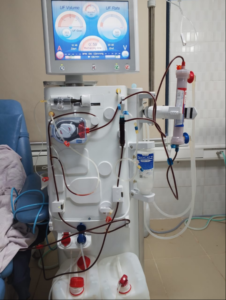
ight new dialysis machines have been purchased, but they lack a dialysis chair or bed and are still uninstalled, according to sources within the hospital. This is purportedly because the staff have not received the necessary training.
Our sources also questioned management’s choice to buy equipment from a different manufacturer instead of continuing to work with the Japanese government, which had previously provided and supported the center with necessary resources, including the current machinery.
Two are said to have passed away during treatment.
Additionally, there are unsettling rumors that two dialysis patients passed away on Tuesday, June 30, 2026. According to sources, both individuals tragically perished as a result of defective and outdated dialysis equipment while receiving treatment.
Although construction started in 2011 under former President Johnson Sirleaf, the facility was formally dedicated on March 1, 2022, during the administration of former President George Manneh Weah.
Serving hundreds of patients from all fifteen counties, the John F. Kennedy Medical Center, which is overseen by the Ministry of Health, has greatly decreased the need for Liberians suffering from renal failure to travel overseas for treatment.
Patients and medical professionals are urging the Government of Liberia (GoL) and health authorities to immediately address the reported lack of operational machines, increase staffing, extend operating hours, and guarantee that newly acquired equipment is installed without further delay as the demand for dialysis services keeps rising.
As the demand for dialysis services continues to rise, patients and healthcare workers are calling on the Government of Liberia (GoL) and health authorities to urgently address the reported shortage of functional machines, extend operating hours, improve staffing and ensure that newly acquired equipment is installed without further delay.
The allegations contained in this report are based on interviews with patients and anonymous staff members.
Story was first published by Front Page Africa