












Côte d’Ivoire and Botswana are seeking to deepen economic cooperation with a focus on agriculture, mining, energy, industrial development, and trade, as both countries pursue strategies aimed at generating greater value from Africa’s natural resources before they reach international markets.
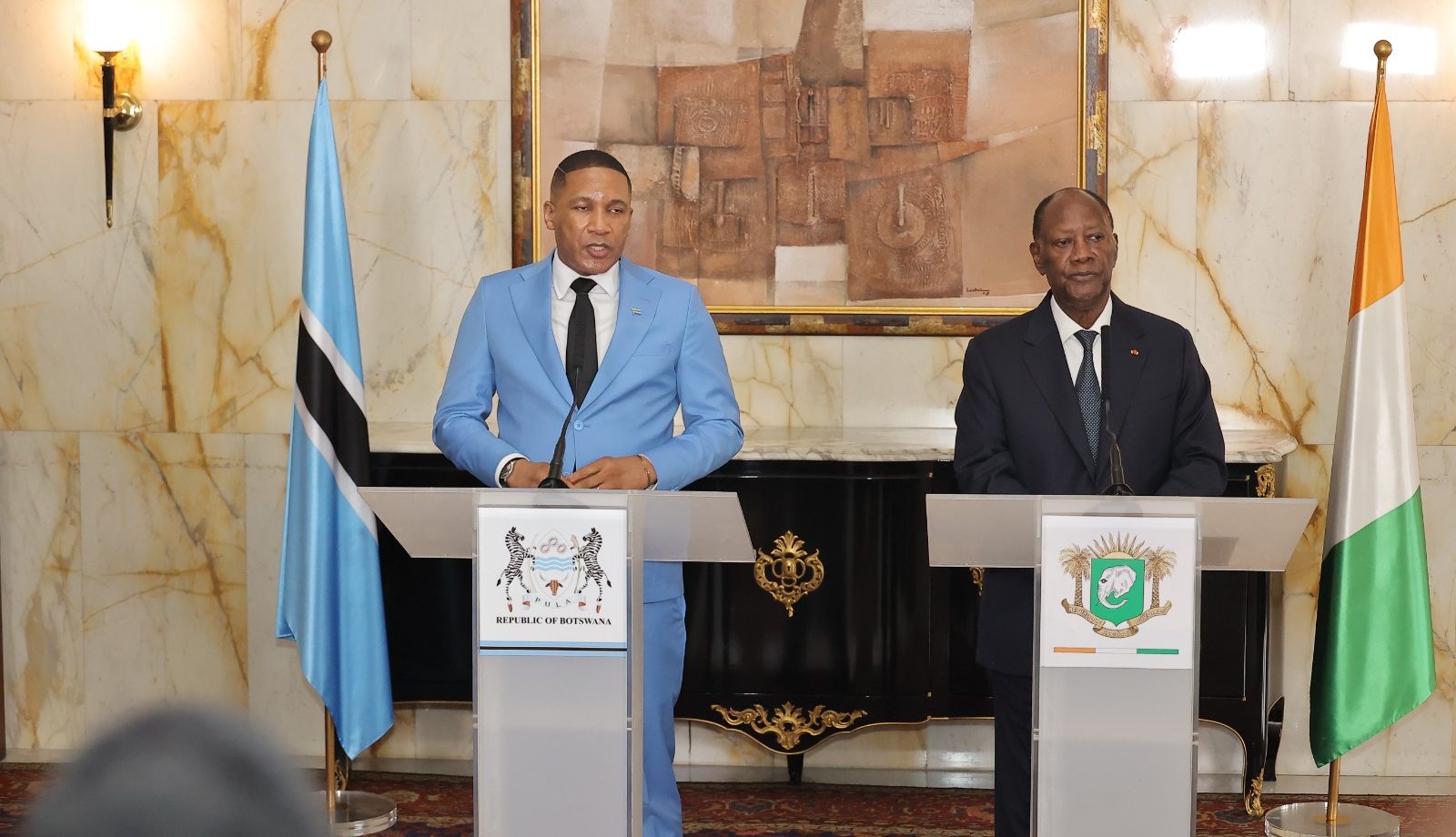
The commitment was reaffirmed during talks between Ivorian President Alassane Ouattara and Botswana’s President Duma Gideon Boko at the Presidential Palace in Abidjan-Plateau on Monday, as part of Boko’s state visit to Côte d’Ivoire.
Accompanied by senior government officials and approximately 60 business leaders, President Boko’s visit underscored growing efforts by both nations to strengthen economic ties, attract investment, and expand commercial partnerships in key sectors of their economies.
Following the meeting, President Ouattara welcomed the Botswana delegation and emphasized the importance of stronger South-South cooperation among African nations.
He also praised Botswana’s participation in CIREX 2026 as Guest of Honour and commended the country’s economic achievements and governance record under President Boko’s leadership.
Ouattara further acknowledged Boko’s role in continental public health initiatives through the African Leaders Malaria Alliance (ALMA), which the Botswana leader has chaired since February 2025.
Mining, Energy and Agriculture Drive Cooperation Agenda
Economic cooperation featured prominently during the discussions, particularly following a Memorandum of Understanding signed in Gaborone in June 2026 covering mining, petroleum, and energy.
President Ouattara described the agreement as a significant step toward expanding bilateral relations and identified agriculture, livestock production, agribusiness, mining, and petroleum as sectors with strong potential for collaboration.
An economic forum bringing together business leaders from both countries was organized alongside the state visit, reflecting efforts to translate diplomatic engagement into commercial partnerships.

Ouattara encouraged Botswana’s private sector to explore investment opportunities in Côte d’Ivoire, particularly in mining, petroleum, and infrastructure projects linked to the country’s 2026–2030 National Development Plan.
Adding Value to African Resources
A central theme of the discussions was the need for African countries to retain a greater share of the value generated from their natural resources through local processing and industrialization.
Drawing on Botswana’s experience as one of the world’s leading diamond producers, President Boko argued that resource-rich nations must move beyond the export of raw commodities and develop industries that create jobs, increase revenues, and strengthen economic resilience.
He noted that the economic relationship between Botswana and Côte d’Ivoire reflects broader opportunities for cooperation among African countries seeking to diversify their economies and expand value-added production.
Boko also drew parallels between Botswana’s diamond industry and Côte d’Ivoire’s position as a major producer of cocoa and cashew nuts.
According to the Botswana leader, the value of agricultural commodities should extend beyond their market price to include their origin, production history, and the contribution of the farmers who produce them.
He said Ivorian cocoa derives part of its value from the knowledge, labour, and experience of the communities involved in its cultivation.
His remarks highlighted a broader challenge confronting many African economies: how to move up global value chains by processing raw materials domestically rather than exporting them in unprocessed form.
Call for Stronger Intra-African Trade
Beyond bilateral cooperation, President Boko used the occasion to advocate for deeper continental economic integration.
He called for improved trade corridors and greater harmonization of regulations, laws, and business practices across Africa to facilitate the movement of goods and services.
According to Boko, regulatory and administrative barriers continue to constrain trade between African countries despite ongoing efforts to implement regional trade agreements.
Reducing those obstacles, he said, would help stimulate investment, expand market access, and strengthen economic cooperation across the continent.
For businesses in both Côte d’Ivoire and Botswana, closer commercial ties could create new opportunities to enter emerging markets, establish strategic partnerships, and diversify sources of investment and supply.
Regional and Global Issues Discussed
The two leaders also exchanged views on a range of regional and international developments.
Their discussions covered security challenges in West Africa, the Great Lakes region, Sudan, and the Horn of Africa, as well as conflicts in other parts of the world and their implications for African economies.
Both sides emphasized the importance of enhanced dialogue and cooperation among African nations in responding to evolving economic and security challenges.
Toward a New Phase of African Economic Partnership
President Boko’s visit marks a new phase in relations between Abidjan and Gaborone, with both countries seeking to translate political goodwill into practical economic outcomes.
While Botswana brings extensive experience in mineral resource management, Côte d’Ivoire offers significant opportunities in agriculture, agribusiness, energy, mining, and industrial development.
The success of the partnership will ultimately depend on the ability of both countries to convert diplomatic commitments into concrete investments, technology transfers, and sustainable business ventures.
As African governments increasingly seek to capture more value from their natural resources and strengthen trade within the continent, the growing partnership between Côte d’Ivoire and Botswana reflects a broader shift toward value addition, industrialization, and deeper economic integration