









une 1, 2026, Monrovia- Members of the Multi-Actor Platform on Land Governance and Responsible
Agricultural Investment in Liberia (MAP Liberia Land Platform) have elected a new Steering
Committee to serve for the next two years, in keeping with the Bye Laws and Regulations governing
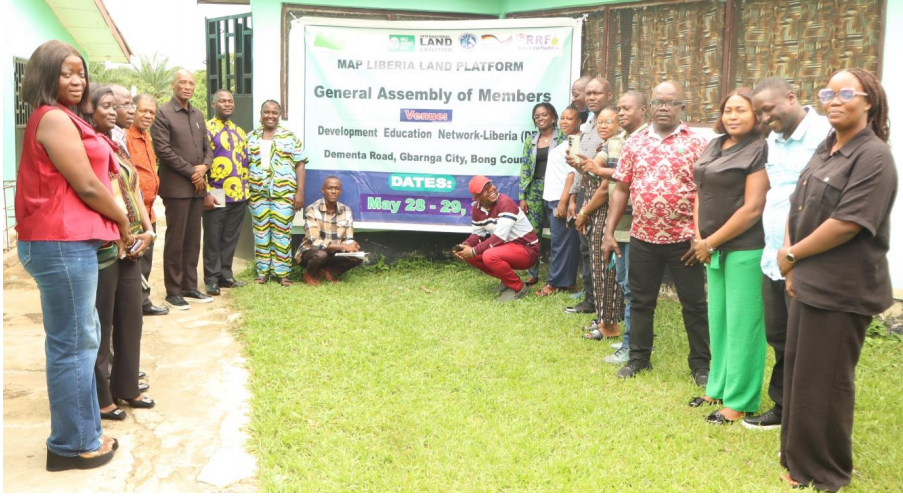
the Platform. This decision was made during the Annual Membership Forum held on May 28-29, 2026, in Gbarnga,
Bong County. The outgoing Steering Committee members, who were elected in May 2024, were
given their flowers when the National Facilitator of the Platform, Mr. James Yarsiah praised the team
for their selfless and dedicated service to the Platform.
Over thirty-five members with diverse expertise in land governance and agriculture—encompassing
research, training, and advocacy—gathered at the Development Educational Network of Liberia
(DEN-L) in Gbarnga to assess the performance of the Platform and highlight its achievements,
strengths, weaknesses, and opportunities. Significant policy decisions regarding the Platform were
made, including a review of its resource mobilization strategy and the adoption of the annual work
plan for 2026, all aligned with the MAP’s five-year country strategy.The membership of the Platform includes national civil society organizations, community-based
organizations (CSOs/CBOs), government agencies, academia, research institutions, and private
sector actors.
Election of Committee members
Eleven member institutions representing various sectors—including the Liberia Land Authority (LLA),
the Ministry of Agriculture, civil society organizations, the private sector, youth and women-led
institutions, and People with Disabilities (PwDs) have been elected to the MAP Steering Committee.
The elected institutions include the Liberia Land Authority, the Ministry of Agriculture, Girl for
Excellent Performance (GEP), Women Care Initiative (WOCI), private sector representatives, the
University of Liberia’s Department of Environmental Studies and Climate Change, the South-eastern
Women Development Association (SEWODA), and members of the Community Land Development
Management Committee (CLDMC) from the Western and South-eastern regions.
During the opening of the forum, Mr. David Akoi, Deputy Minister for Planning and Development at
the Ministry of Agriculture, emphasized that the Ministry operates under the National Agriculture
Development Plan (NADP). This plan focuses on transitioning Liberia from low-scale subsistence
farming to sustainable commercial agribusiness.
“I want to assure you that the Ministry of Agriculture does not view MAP as an external project. You
are an institutional partner. Your feedback directly shapes how we deploy resources, how we refine
our policies, and how we interact with international donors”, he asserted.
“Serving on the Steering Committee has given me first-hand insight into the challenges of advancing
a multi-stakeholder platform. It is not easy to bring together large agricultural concessions,
smallholder farmer cooperatives, and civil society advocates at the same table to find common
ground. It requires patience and transparency,” the Deputy Minister added.
Mr. Ezekiel Weah, Assistant Director of the Customary Land Division at the Liberia Land Authority,
also spoke at the forum. He explained that the Liberia Land Authority is responsible for regulating,
managing, and utilizing land, and noted that customary land accounts for 75% of land ownership in
Liberia. He highlighted that the LLA has developed a new deed form aimed at reducing dubious land
sales. Mr. Weah explained to participants that his department has recorded around 75 customary
communities that have gone through the customary land formalization process. This process he said
has 6 steps, which includes all communities must follow.
He expressed hope that the MAP Platform members will educate citizens in their counties to follow these procedures to be able to get their deeds.
Why the MAP Annual Membership Forum?
The MAP Annual Membership Forum is the highest decision-making body of the Platform. It brings together all registered members to assess the Platform’s performance over the past year, reflect on governance, review major achievements, challenges, and opportunities, approve significant policy
decisions, and admit new members. The Forum takes major decisions for the platform including Platform’s 5 year Country Strategy as well as the annual work plans, electing Steering Committee members every two years, and providing future policy direction for the Platform.
After much deliberations the Platform said that it will support the 2 regional platform co conveners in the western and southeast of the country, but that eventually the MAP should be established at the county level in order to reach the beneficiaries better and at a reasonable operational cost.