








ABIDJAN, Côte d’Ivoire — September 10, 2026 — The Ivorian Government has approved a series of major economic, environmental, petroleum and healthcare measures aimed at strengthening state financial capacity, expanding national control over petroleum assets, protecting biodiversity and improving access to essential medical supplies.
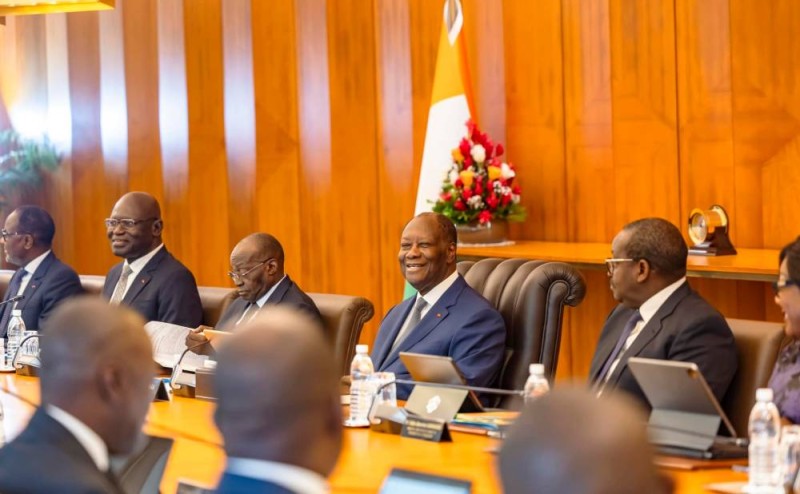
The decisions were taken during the Council of Ministers held on Wednesday, September 9, 2026, at the Presidential Palace in Abidjan under the chairmanship of President Alassane Ouattara.
Among the key decisions was the approval of an ordinance amending the law governing the “Caisse des Dépôts et Consignations” de Côte d’Ivoire (CDC-CI).
According to the Government, the reform is intended to strengthen and expand the institution’s operational capacity to mobilize additional financial resources for the State and contribute to the financing of the national economy.
The amended framework expands the resources that can be mobilized by the CDC-CI and grants the institution definitive ownership and management of funds deposited in its accounts that have become subject to statutory limitation.
The reform also introduces financial and administrative enforcement mechanisms against entities or individuals required to comply with the institution’s procedures.
State takes control of CI-26 oil block
In another major decision, the Council of Ministers authorized the creation of PETROCI CI-26, a new subsidiary of PETROCI HOLDING that will take over and operate oil Block CI-26, known as Champ Espoir.
PETROCI CI-26 will be established as a public limited company whose entire share capital will be held by PETROCI HOLDING.
The new company will assume responsibility for the petroleum block following the expiration of the authorization previously granted to operators that had exclusive rights to exploit the asset.
The Government said the creation of PETROCI CI-26 will allow the State to take over the relevant petroleum assets and continue their exploitation in accordance with Côte d’Ivoire’s existing petroleum and state-owned company legislation.
The move highlights the government’s continued efforts to strengthen national participation in the country’s oil and gas sector and maintain control over strategic petroleum assets.
SOGB forest reserve covers approximately 4,000 hectares
The Government also approved the creation of a Voluntary Nature Reserve belonging to the Société des Caoutchoucs de Grand-Béréby (SOGB) in the Grand-Béréby sub-prefecture of San-Pedro.
The protected area covers approximately 4,000 hectares and consists of 16 forest islands located within SOGB’s agro-industrial complex.
The Government said the reserve contains endemic West African plant species as well as significant wildlife species.
The initiative forms part of the government’s broader strategy to protect biodiversity and expand Côte d’Ivoire’s network of protected areas through private-sector participation.
The decision is also significant for the country’s rubber industry, demonstrating an effort to combine agricultural and industrial activities with the conservation of forest ecosystems.
Côte d’Ivoire expands drone-based medical distribution
The Council further approved a communication concerning a public-private partnership between the Republic of Côte d’Ivoire and ZIPLINE SARL for the development of a nationwide drone-based medical distribution network.
The agreement, signed in December 2025, provides for the construction and operation of 10 storage and distribution centers for medical products, including strategic medical supplies and blood products.
The system is designed to improve the regular and secure delivery of medical supplies to health facilities located in areas that are difficult to access through conventional transportation networks.
The project will be implemented in two phases.
The first phase, scheduled over 27 months, will involve the opening of a pilot center in Daloa, alongside facilities in Biankouma, San-Pedro and Kouto.
The second phase will extend the network to six additional centers located in the Autonomous District of Abidjan and the regions of Indénié-Djuablin, Gbêkê, Kabadougou, Bélier and Gontougo.
The project will receive support from the United States Government through a grant to establish the required infrastructure, while the Ivorian State will finance the associated service provision.
Strengthening strategic sectors
The decisions adopted during the Council of Ministers reflect the government’s focus on strengthening national economic capacity while expanding private-sector participation in environmental protection and modernizing public services.
The creation of PETROCI CI-26 could increase the State’s direct involvement in petroleum operations, while the SOGB nature reserve represents a growing intersection between industrial agriculture and biodiversity conservation.
Meanwhile, the ZIPLINE partnership is expected to improve healthcare logistics by using drone technology to overcome geographical and transportation challenges.