









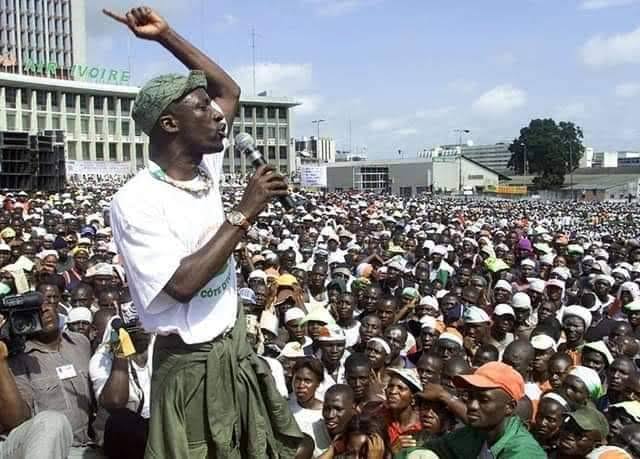
ABIDJAN, Côte d’Ivoire, Oct. 2, 2026 — Twenty-four years after a mass political mobilization took place in Abidjan amid Côte d’Ivoire’s 2002 armed conflict, former youth leader Charles Blé Goudé is revisiting a day he describes as one of the most consequential moments of his political career.
The gathering, held on Oct. 2, 2002, occurred less than two weeks after an armed uprising erupted on Sept. 19, triggering a political and military crisis that ultimately split the country between government-controlled territory in the south and rebel-held areas in the north and west.
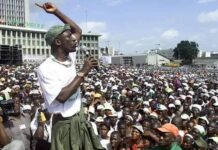
According to records presented during proceedings before the International Criminal Court (ICC), Blé Goudé played a central role in organizing the Oct. 2 demonstration in support of Côte d’Ivoire’s republican institutions. The event drew large crowds and marked one of the first major public mobilizations following the outbreak of the conflict.
ICC records further indicate that Blé Goudé returned to Abidjan on Sept. 26, 2002, after interrupting studies at the University of Manchester in the United Kingdom in the wake of the armed attacks.
Return to a Country in Crisis
Blé Goudé’s return came at a time of heightened uncertainty.
Having traveled to the United Kingdom in November 2001 to pursue academic studies, he cut short his stay abroad and returned to Côte d’Ivoire one week after the Sept. 19 uprising, according to information compiled by this reporter.
The uprising was initially characterized by authorities as an attempted coup d’état, though it later evolved into a broader armed conflict that would shape the country’s political trajectory for years.
Blé Goudé has said his objective upon returning was to help organize a peaceful youth mobilization in support of the state during a period of national emergency.
The October 2 Mobilization
The Oct. 2 gathering quickly became a significant episode in the political response to the crisis.
A 2003 report by the International Crisis Group (ICG) described the demonstration as the first major organized public mobilization after the outbreak of hostilities and noted the participation of several political parties and youth organizations. The report also highlighted the subsequent emergence of youth movements associated with Blé Goudé, including the Alliance des Jeunes Patriotes pour le Sursaut National, which became increasingly influential during the conflict.
Blé Goudé has since offered his own account of the circumstances surrounding the event.
In remarks reported in 2022, he said some individuals within political circles close to then-President Laurent Gbagbo initially opposed the proposed gathering and sought to prevent it from taking place. According to Blé Goudé, he rejected those objections and moved forward with the initiative.
He also recalled logistical challenges, including difficulties securing sound equipment, and said supporters ultimately helped provide the resources needed for the event.
Those assertions reflect Blé Goudé’s personal recollections and have not been independently verified.
Competing Interpretations of History
The legacy of the Oct. 2 mobilization remains the subject of differing political and historical interpretations.
Supporters of Blé Goudé and the youth movements that emerged around him view the demonstration as a popular expression of resistance against the armed challenge to the government and constitutional order.
Other observers have offered more critical assessments. The International Crisis Group and other analysts documented the increasingly confrontational role of some youth movements during the conflict and their contribution to broader political tensions.
These differing perspectives underscore the complexity of revisiting events that unfolded during one of Côte d’Ivoire’s most turbulent periods.
The Oct. 2 gathering cannot be examined in isolation from the wider crisis, which was marked by armed violence, deep political polarization and allegations of human rights abuses by multiple actors.
A Date That Continues to Resonate
For Blé Goudé, Oct. 2 remains more than a historical milestone.
The date symbolizes his return from the United Kingdom, his emergence as a prominent political figure during a national emergency and the mobilization of thousands of young Ivorians at a moment when the country faced the prospect of prolonged conflict.
In subsequent interviews and public statements, he has continued to emphasize aspects of the episode that he believes have received insufficient attention, including the circumstances of his return to Côte d’Ivoire, the organization of the gathering and the resistance he says he encountered from some political actors.
Available historical records support certain elements of his account, notably his return to Abidjan on Sept. 26, 2002, and his involvement in initiating the Oct. 2 mobilization. Other aspects, including alleged disagreements within pro-government circles and details concerning the event’s organization, remain matters of personal testimony and political interpretation.
Reflecting on a Broader National Crisis
The anniversary offers an opportunity not only to recall the thousands who participated in the Oct. 2 demonstration, but also to reflect on the far-reaching consequences of the crisis that began in September 2002.
The conflict profoundly affected Côte d’Ivoire’s political institutions, social cohesion and national unity, leaving a legacy that continued to shape public life long after the guns fell silent.
Understanding Oct. 2, 2002, requires consideration of multiple perspectives: the government’s response to the armed uprising, the mobilization of youth, the emergence of new political actors, the experiences of civilians and the violence and divisions that followed.
Twenty-four years later, Charles Blé Goudé’s recollections add another perspective to a chapter of Ivorian history that remains both influential and contested.