












By Willie Bestman
Liberia has called for a stronger and more structured partnership between the United Nations (UN) and the African Union (AU) to better prevent and respond to emerging conflicts across Africa.
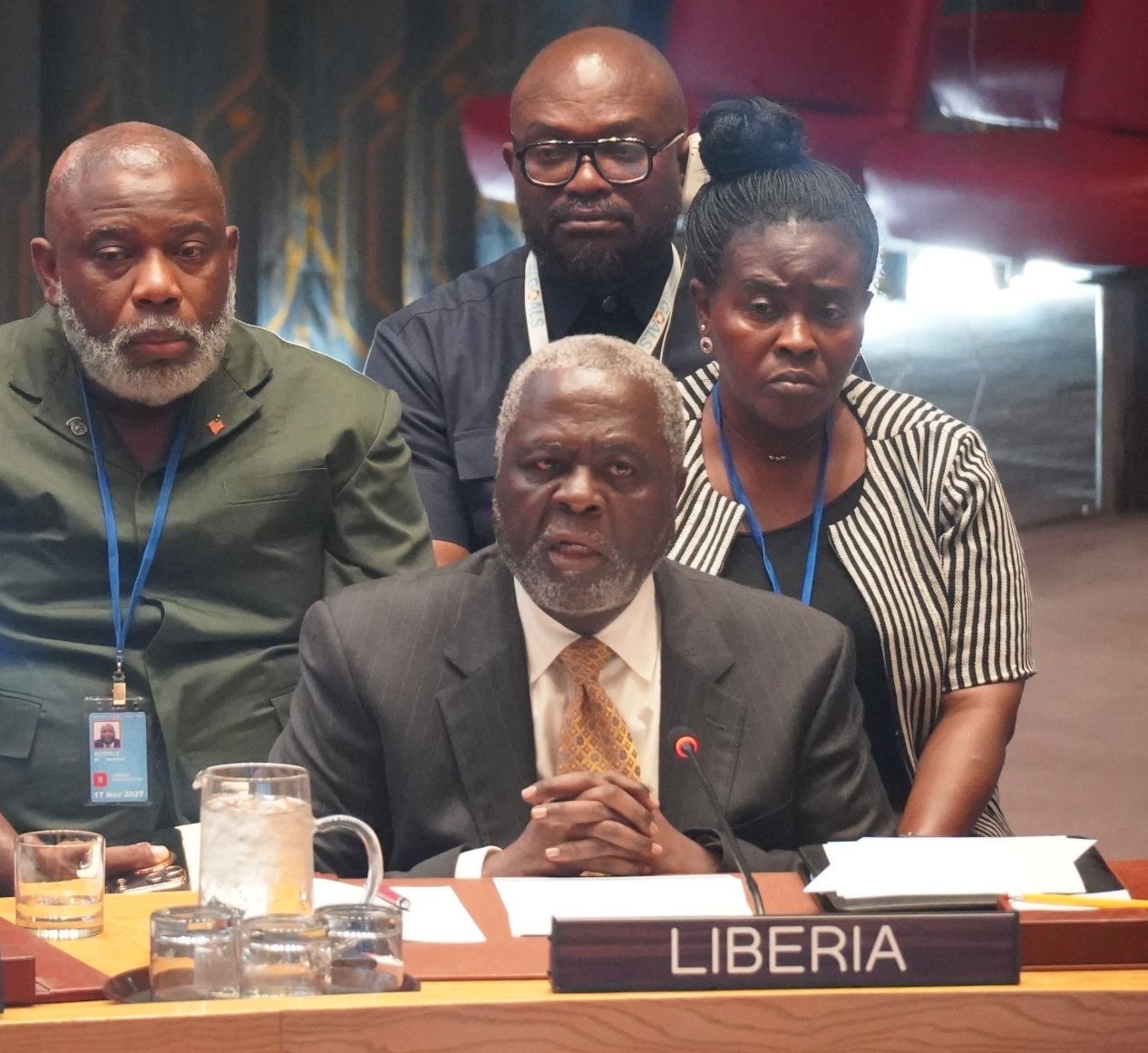
Addressing a United Nations Security Council briefing on Tuesday on cooperation between the UN and regional organizations in maintaining international peace and security, Liberia’s Permanent Representative to the UN, Ambassador Lewis G. Brown II, urged both institutions to move beyond reactive cooperation and build a partnership centered on prevention and coordinated action.
“Africa does not need another catalogue of crises,” Brown told the Council, noting that sub-Saharan Africa remains a major security concern, with six of the world’s ten countries most affected by terrorism located in the region despite a reported global decline in terrorism in 2025.
The Liberian envoy emphasized that the UN-AU relationship should evolve from what he described as “a partnership by circumstance” to “a partnership by design,” focused on anticipating and preventing conflicts before they escalate.
Drawing on Liberia’s own history, Brown said the country’s transition from civil war to lasting peace illustrates the value of combining national ownership, regional leadership, and international support.
“Libera’s journey from war to peace demonstrated what becomes possible when national ownership, regional leadership, and international solidarity reinforce one another,” he said.
Brown commended the contributions of the United Nations, the Economic Community of West African States (ECOWAS), and the African Union in supporting Liberia’s peace and reconstruction efforts following years of conflict.
“Peace is strongest when it is nationally owned, regionally anchored, and internationally supported,” he added.
Liberia outlined five priority areas for strengthening the UN-AU partnership, beginning with greater investment in conflict prevention.
“Prevention should be the first investment, not the last resort,” Brown said, stressing that early-warning systems are only effective when they lead to timely action.
He noted that while the African Union has developed valuable continental and subregional early-warning capabilities, the United Nations brings global reach, political influence, and convening power that can complement those efforts.
Liberia also advocated for stronger institutional coordination between the UN Security Council and the African Union Peace and Security Council, including more systematic information-sharing and earlier engagement when potential threats emerge.
In addition, the country called for the full implementation of UN Security Council Resolution 2719, which was unanimously adopted in 2023 and established a framework for financing AU-led peace support operations through UN-assessed contributions on a case-by-case basis.
“A framework on paper cannot protect a civilian in danger,” Brown said. “Predictable financing must become predictable capacity, supported by clear mandates, credible oversight, accountability, respect for international humanitarian and human rights law, and realistic political strategies.”
He cautioned against treating peacekeeping and peacebuilding as separate efforts, arguing that regional ownership and accountability must advance together to ensure sustainable peace.
On counterterrorism, Liberia called for a comprehensive approach that includes enhanced intelligence-sharing, stronger border security cooperation, measures to disrupt terrorist financing, improved judicial capacity, and greater investment in community resilience.
Brown urged the UN and AU to deliver practical outcomes rather than issuing another declaration without implementation.
He called for stronger early-warning cooperation, earlier preventive diplomacy, clearer implementation mechanisms for Resolution 2719, regular consultations between the two organizations, and measurable follow-up on commitments already made.
Liberia reaffirmed its belief that effective multilateral cooperation is essential to addressing Africa’s security challenges and stressed that future UN-AU partnerships should be judged by the speed and effectiveness of their collective response rather than by which institution acts first.
“The true measure of our partnership,” Brown suggested, “is not who moves first, but how quickly and effectively we move together.”